The most expensive AI tool in your enterprise is probably one you do not know exists.
It is the ChatGPT account an analyst created with her personal email to summarize earnings calls. It is the Claude tab a developer keeps open to debug production issues at 2am. It is the AI-powered browser extension a marketing manager installed last week that is now reading every Slack message in the company.
This is Shadow AI. And it is one of the costliest aspects of the AI adoption crisis, precisely because it is the one least visible to leadership.
The Scale of Shadow AI
The numbers, from our whitepaper synthesis:
Fresh 2026 research confirms the trend has accelerated. 98% of organizations have employees using unsanctioned apps, including shadow AI2. According to Gartner, 69% of organizations suspect or have evidence that employees are using prohibited public GenAI tools3.
Microsoft’s research found 71% of UK employees admitted to using unapproved AI tools at work, with 51% doing so at least once a week3.
This is not occasional experimentation. It is a parallel technology stack operating in every enterprise.
Why Shadow AI Is Different From Shadow IT
Shadow IT is an old problem. Employees have always used unauthorized Dropbox accounts, personal Slack channels, unapproved SaaS tools. The risk is real, but bounded. Data sits somewhere it should not. Access is harder to revoke. Procurement loses leverage. Manageable.
Shadow AI is not the same problem at a different scale. It is a fundamentally new category of risk. Three differences matter:
Data goes out, not just in
An unauthorized Dropbox file sits where IT can’t see it. The same file pasted into an AI tool is actively processed, potentially used for training, and may become part of model weights you cannot extract from.
The data is unrecoverable
A misplaced file can be deleted. Data absorbed into a neural network cannot. “You cannot request deletion from a neural network the way you can delete a file from a server.”5
The outputs drive decisions
Shadow IT affects where data lives. Shadow AI affects what decisions get made. Bad legal interpretation, incorrect financial guidance, flawed technical advice, with no audit trail. Errors compound silently.
The Productivity Side of the Cost
Most Shadow AI coverage focuses on security risk. That coverage is justified, but it misses half the cost.
The whitepaper’s finding is striking: employees lose roughly 35 hours per month partly due to fragmented AI tool use1.
How does AI tool use cause lost productivity? Three ways:
- Tool switching overhead. An employee using four different AI tools across the day (ChatGPT for one task, Claude for another, an embedded Notion AI for a third, a personal Copilot subscription for a fourth) spends real time reformatting prompts, re-uploading context, and reconciling outputs.
- Quality variance. Different tools produce different outputs for similar prompts. Time spent comparing, validating, and choosing between outputs is time not spent on the underlying work.
- Rework from low-quality outputs. Free-tier AI tools used without enterprise guardrails produce more hallucinations, more outdated information, and more errors that require human correction. Each correction is rework.
At a fully-loaded salary of $75,000 per employee, those 35 monthly hours represent roughly $15,000 in annual productivity loss per affected employee1.
For a 500-employee organization with 80% Shadow AI prevalence, the math is:
| Calculation | Value |
|---|---|
| Affected employees | 400 |
| Annual productivity loss per employee | $15,000 |
| Total annual productivity loss | $6,000,000 |
Six million dollars, invisible on any P&L line item. Distributed across every department. Attributable to no single tool. This is what makes Shadow AI so costly: the loss does not show up where finance is looking.
The Security Side of the Cost
The productivity leak is the half most enterprises miss. The security side is the half that gets boardroom attention. The numbers, from 2025 and 2026 incident data:
The most-cited real-world example is Samsung. Three semiconductor engineers leaked proprietary data within a single month by pasting source code, meeting transcripts, and chip yield test sequences into ChatGPT. Samsung initially banned ChatGPT, then reversed the decision in favor of developing an internal AI solution4.
The Samsung pattern is the pattern. Reactive bans fail. Employees route around them. The data has already left.
Why Employees Bypass IT
Shadow AI is not driven by malice. It is driven by friction. The pattern from 2026 employee research:
- Employees choose speed over process. In healthcare, 50% of administrators cite faster workflows as the primary motivation for unauthorized AI adoption4
- Enterprise-approved tools are slower to provision. By the time IT approves, employees have been using a personal alternative for months
- Enterprise tools often have inferior features. Free-tier ChatGPT or Claude is frequently better than the locked-down enterprise alternative
- Approval processes are opaque. Employees do not know what they would need to do, so they do not try
The result is a structural mismatch: IT controls what gets procured, but employees control what gets used. When those two diverge, Shadow AI fills the gap.
What Works: Approved Alternatives Beat Bans
The single most consistent finding across 2026 Shadow AI research:
When approved enterprise-grade AI alternatives are provided, unauthorized AI usage drops by 89%. Source · Vectra AI, 20264
That is the highest-leverage governance intervention available. It is also the one most enterprises skip, in favor of policies.
Policies alone do not work. Mimecast’s 2026 State of Human Risk report found that 80% of organizations worry about data leaking through generative AI, but 60% still have no specific strategy to address it, and only 40% feel fully prepared7.
Blocking does not work either. New AI tools appear daily. Employees use personal devices. VPNs and proxies bypass network controls. Trying to block every AI tool is, as one security analyst put it, “trying to drain the ocean with a teaspoon.”
What works is governance over prohibition: provide secure alternatives, set clear rules, monitor usage, and audit regularly.
The Five-Step Framework Applied to Shadow AI
The whitepaper’s measurement framework was designed for AI ROI, but it applies cleanly to Shadow AI as well.
The $1.25M Opportunity
For organizations willing to address Shadow AI directly, the upside is documented.
The savings come from three places:
- License consolidation. Replacing 15 unmanaged personal AI subscriptions with one enterprise contract typically reduces gross AI spend by 30-50%.
- Eliminated rework. Replacing low-quality free-tier outputs with enterprise-grade outputs reduces correction cycles.
- Avoided breach cost. Reducing the probability of a Shadow-AI-driven data breach reduces expected loss across the organization.
The savings are real and trackable. They just require the discipline to make Shadow AI visible first.
The Bottom Line
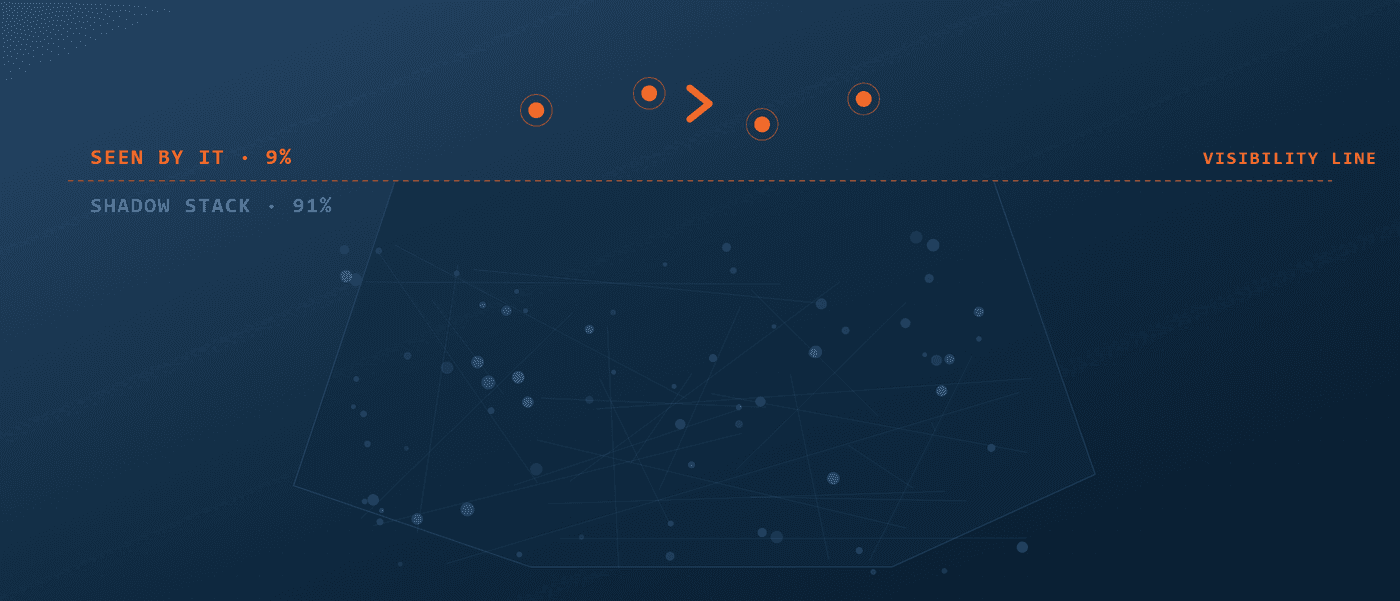
Shadow AI is the iceberg. The 9% of AI use that IT can see is the visible tip. The 91% beneath the waterline is where the cost lives.
The productivity leak (around $15,000 per affected employee per year) and the security risk (around $670,000 added to every breach) compound. Both are invisible until measured. Both are addressable with governance, not prohibition.
The 89% reduction in unauthorized usage that follows when enterprises provide approved alternatives is the most actionable Shadow AI statistic in current research. The answer to Shadow AI is not control. It is alternatives, measurement, and ownership.
The enterprises that move first to make Shadow AI visible are the ones that will harvest the $1.25M annual savings. The ones that do not will continue to pay both halves of the cost without ever knowing what they paid for.
References
- 01 Uprovd Research · 2026 The AI Adoption Reality Check: When Investment Outpaces Measurement Read the whitepaper →
- 02 Programs.com · 2026 Shadow AI Statistics: How Unauthorized AI Use Costs Companies programs.com/resources/shadow-ai-stats →
- 03 Olakai · 2026 · citing Gartner & Microsoft Work Trend Index Shadow AI: The Enterprise Risk You Cannot Afford to Ignore olakai.ai/blog/shadow-ai-risk →
- 04 Vectra AI · 2026 · citing IBM, CybSafe/NCA, Harmonic, Healthcare Brew Shadow AI Explained: Risks, Costs, and Enterprise Governance vectra.ai/topics/shadow-ai →
- 05 SentinelOne · 2026 · citing ISACA What Is Shadow AI? Definition, Risks & Governance Strategies sentinelone.com/cybersecurity-101 →
- 06 DevJournal · 2026 · citing IBM Cost of a Data Breach Report 2025 Enterprise AI Governance 2026: Shadow AI Growth and the Failure of Traditional Policies earezki.com/ai-news →
- 07 Mimecast · 2026 · citing State of Human Risk 2026 Shadow AI: The Hidden Threat Quietly Undermining Your Business mimecast.com/blog/shadow-ai →