
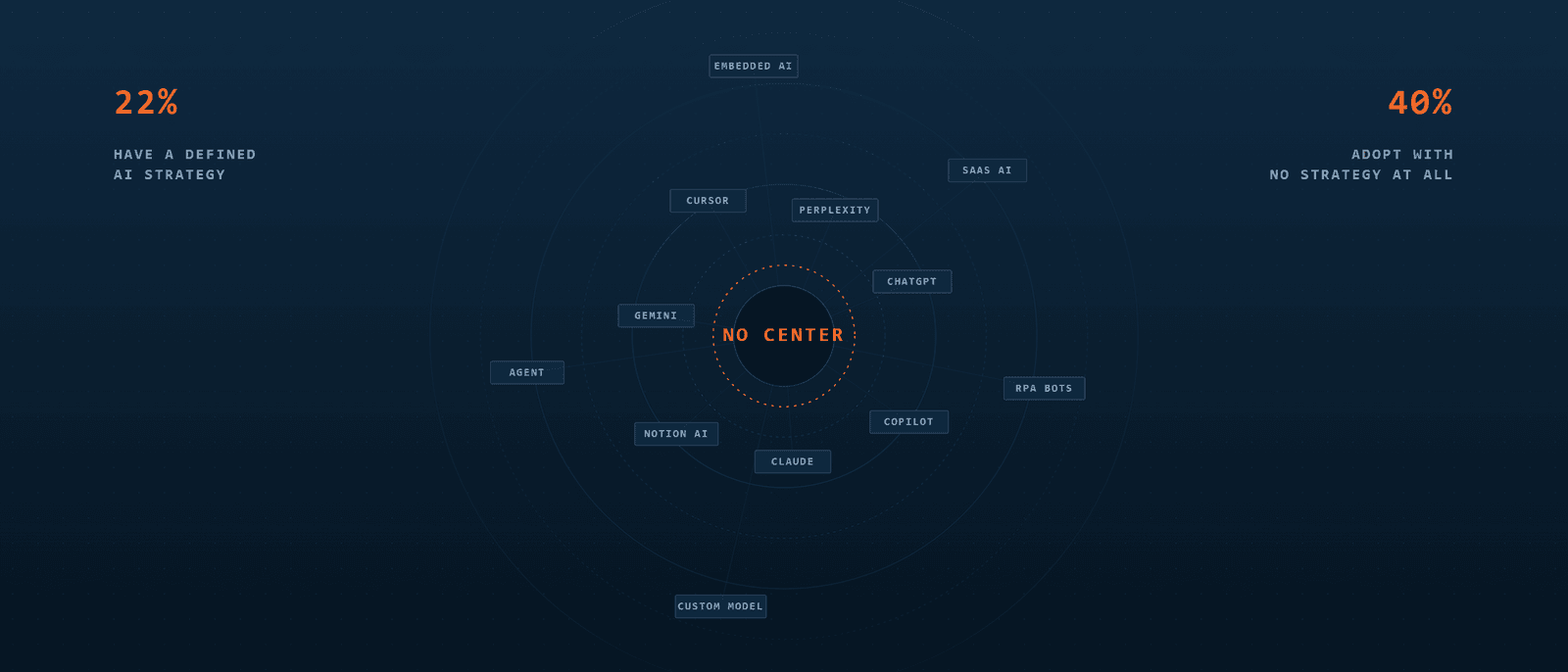
There is a quiet problem inside almost every enterprise running AI today.
The tools are everywhere. ChatGPT licences. Copilot rollouts. RPA bots. Custom models. AI features inside existing SaaS. By any count, AI has won the adoption battle.
But ask a CIO or CFO this question and watch what happens:
“What is our AI strategy?”
Most cannot answer it without starting a meeting first.
This is the strategic vacuum. And it is the single most expensive gap in enterprise AI today.
The Numbers
The data on strategic readiness is consistent across every major 2025 and 2026 study.
- Only 22% of organizations have a visible, defined AI strategy 1
- 40% are adopting AI with no strategy at all 1
- Organizations with AI strategies are 2× more likely to experience revenue growth from AI and 3.5× more likely to achieve critical AI benefits 1
- 67% of enterprises admit they do not have complete visibility into which AI tools their employees are using 1
- Only 24% have an AI governance program, rising to just 34% in large enterprises 1
Fresh 2026 research reinforces the same pattern. Writer’s 2026 Enterprise AI Adoption survey found that 97% of executives report individual benefit from AI, but only 29% see significant organizational ROI 2. The gap between “AI is helping me” and “AI is helping our company” is the strategy gap, made visible.
What “No Strategy” Actually Looks Like
The phrase “AI strategy” gets used loosely. It is worth being concrete about what its absence looks like in practice.
A company without an AI strategy typically has all of these:
- AI tools procured by individual teams, with no central inventory
- No defined business outcome any specific AI deployment is expected to produce
- No baseline measurement against which to compare post-AI performance
- No owner accountable for AI value at the leadership level
- No criteria for deciding which AI investments to kill, scale, or maintain
- A budget line that grows every quarter without a corresponding accountability line
A company with an AI strategy has at least four of those things resolved.
The presence of tools is not strategy. Strategy is the answer to: what are we trying to achieve, with which AI investments, measured how, owned by whom, and what would make us stop?
Why So Many Enterprises Skipped This Step
The vacuum is not the result of negligence. It is the predictable outcome of how AI entered the enterprise.
Most enterprise software comes top-down. IT evaluates, finance approves, business adopts. AI did not follow this path. It entered through employees, through embedded features in tools the company already used, through individual experiments that turned into team workflows that turned into departmental dependencies.
By the time leadership noticed AI was everywhere, it already was.
The strategic vacuum is what happens when the procurement layer of the enterprise gets bypassed faster than the governance layer can catch up.
The Cost of the Vacuum
This is where the question gets interesting for CFOs.
Global enterprise AI spend reached $227 billion in 2025, growing at 3.2× year-on-year. The average organization is now spending $85,521 per month on AI tools, up 36% from 2024. 45% of companies spend over $100,000/month 1.
That spend exists. It is being approved every quarter. What is missing is the discipline to know whether it is working.
The result, in two parts:
First, the measurement gap. 74% of organizations say they have achieved ROI from GenAI. Only 29% say they can confidently measure it 1. That 45-point gap between “we think it is working” and “we can prove it” is the strategic vacuum’s most direct financial signature.
Second, the failure gap. 95% of generative AI pilots are failing to deliver measurable business impact, not because the models are bad, but because most pilots start without a defined outcome 3. Without strategy, every pilot is a hypothesis without a test condition.
A Worked Example
Consider two companies, both 1,500 employees, both spending $1 million per year on AI tools.
Company A has no AI strategy. Eleven different teams have procured AI tools. There is no inventory, no baseline measurement, no central owner. When the CFO asks for the ROI, the answer is a slide deck of testimonials.
Company B has an AI strategy. The same $1 million is concentrated on three named business outcomes (support cost reduction, developer velocity, document processing). Each outcome has a baseline KPI locked before deployment, a named owner at the VP level, a defined kill criterion, and a quarterly ROI review.
After 12 months, the typical pattern in 2026 enterprise data:
| Metric | Company A (no strategy) | Company B (with strategy) |
|---|---|---|
| AI tools deployed | 14 | 6 |
| Tools with measurable outcome | 2 | 6 |
| ROI confidence at CFO level | Low | High |
| Annual savings tracked to AI | Unknown | $1.8M to $3.2M |
| Decisions made on AI spend | Renewed by default | Scale, kill, or maintain |
The strategic difference compounds. Company B’s next $1M of AI spend goes toward the outcomes that worked. Company A’s next $1M goes toward whatever the loudest team requests.
This pattern is consistent with what high performers do differently. Organizations with an AI strategy run half as many AI opportunities but achieve 2× the ROI and 2× the scaled solutions 1. Strategy concentrates investment on the bets that work.
The Six Characteristics of Organizations That Have a Strategy
Across 2025 and 2026 research, the characteristics of organizations that have moved out of the strategic vacuum are remarkably consistent.
- Focus on core processes. 62% of AI value comes from core operations (sales, manufacturing, R&D), not IT and HR 1
- Greater ambition. 60% higher AI-driven revenue growth expected. Double the workforce investment 1
- Cost AND revenue focus. 45% integrate AI in cost transformation, versus 10% of others 1
- Fewer, higher-ROI bets. Half as many opportunities, but 2× the ROI 1
- 70-20-10 resource rule. 70% of investment to people and processes, 20% to technology and data, 10% to algorithms 1
- Faster GenAI adoption. Earlier, broader GenAI rollouts enabling content, reasoning, and orchestration 1
The single strongest differentiator: high performers are 3× more likely to have fundamentally redesigned workflows around AI, rather than bolting AI onto existing workflows 1.
The vacuum filler is not more tools. It is workflow redesign, ROI measurement, and named ownership.
What Strategy Looks Like in Practice
For organizations beginning to fill the vacuum, the first move is not procurement. It is documentation.
Three documents close most of the gap:
- The AI inventory. Every AI tool in use, who pays for it, who uses it, what business outcome it is supposed to affect. Most organizations cannot produce this in under two weeks. Producing it is the first act of strategy.
- The measurement charter. For each AI deployment, the pre-deployment baseline KPI, the post-deployment target, the measurement window, and the kill criterion if the target is missed.
- The accountability map. A single named executive owner for each AI outcome. Not “the AI Council.” A person, with budget authority, whose performance review includes the AI outcome.
These three documents do not eliminate the strategic vacuum. They make it visible. And making it visible is what makes it solvable.
The Bottom Line
The strategic vacuum is the most expensive gap in enterprise AI today. It is also one of the most solvable.
The technology already works. The tools are already deployed. The spend is already happening. What is missing is the measurement infrastructure, the named ownership, and the discipline to choose where to invest next based on evidence rather than enthusiasm.
The 22% of organizations that have closed the vacuum are not getting better AI than everyone else. They are getting better answers about their AI.
That is the difference between AI as expense and AI as strategy.
Read next
This analysis is built on our 2026 research synthesis. For the complete framework, global benchmarks, and full bibliography, read The AI Adoption Reality Check, 2026 Uprovd Research Whitepaper.
To see this measurement framework applied to live data, try the demo.
References
- 01 Uprovd Research · 2026 The AI Adoption Reality Check: When Investment Outpaces Measurement Read the whitepaper →
- 02
- 03 MIT NANDA Initiative · 2025 · via Fortune The GenAI Divide: State of AI in Business 2025 fortune.com/mit-report →